


How are you? By Allah's grace, I'm doing very well.
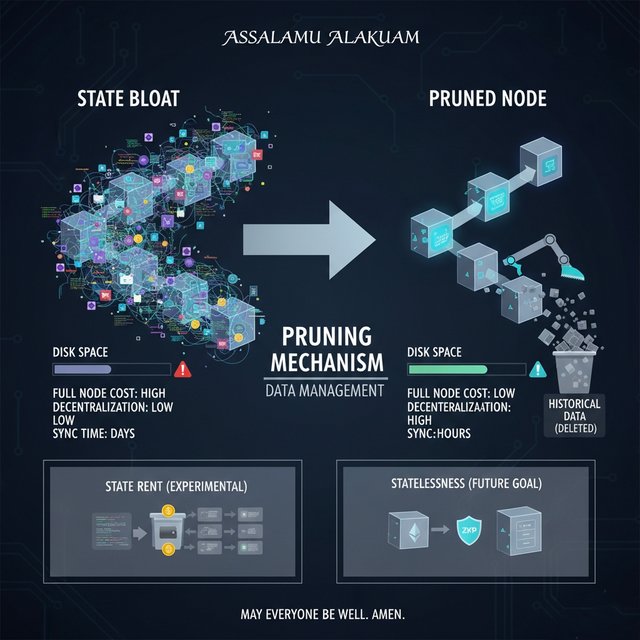
State bloat is a technical problem in blockchains where the internal data of the blockchain network continues to grow. This problem is especially common in smart contract-based blockchains (such as Ethereum), which store not only transaction history, but also the current state of the network.
1. What is state and what is state bloat?
State
The 'state' of a blockchain is a snapshot of the current state of the network at a given time. In the case of Ethereum, state includes :
Account balance : how much ETH or tokens are in each wallet or account.
Smart contract data : The code of each smart contract deployed on the blockchain and the data stored within that code (e.g., the current amount of liquidity pools in DeFi protocols).
State Bloat
Each new transaction or smart contract interaction changes this state of the network and often increases its size. Over time, this continuous growth of data is called state bloat.
2. Problems and Impacts of State Bloat on Performance
State bloat threatens the performance, decentralization, and stability of a blockchain :
Increasing Cost of Running a Full Node : Running a full node currently requires a huge amount of disk space. In the case of Ethereum, this amount of data is over 1 terabyte. This requirement is growing rapidly due to state bloat.
Loss of Decentralization : Since running a full node requires high-powered and expensive hardware, it becomes difficult for ordinary users to run a node. As a result, the number of node operators decreases and the network risks becoming centralized in the hands of a few wealthy or institutional entities.
Node synchronization time : When a new full node needs to sync with the blockchain, it has to download and verify all the data from the beginning to the current state. State bloat makes this synchronization time extremely long (up to several days), which is a major barrier for new participants.
Slow transaction processing : Nodes need to access data from the current state quickly to verify new transactions. The larger the state, the slower the data access speed, which reduces the overall transaction processing speed (throughput).
3. Data management method : Pruning mechanism
Blockchain networks adopt various data management techniques to deal with state bloat, the most important of which is pruning.
What is pruning?
Pruning is a data-reduction technique, where a blockchain node deletes unnecessary or outdated data from its local storage, but maintains the security and functional data (current state) of the network.
- Types of Pruning :
A. Historical Data Pruning
This is the most common pruning technique.
How it works : A full node, after verifying every block and transaction in the blockchain to create a current state, deletes all old blocks and transaction data (that are no longer needed to verify the current state).
Result : The node only stores the current state and relatively recent transaction history. This significantly reduces storage requirements. Such a node is often called a pruned full node or simply a full node.
Limitations : If a user needs old transaction history, they must rely on a special archive node, which stores all the data.
B. State Pruning (experimental)
This technique is more aggressive, where it attempts to delete parts of the state as well.
State Rent : A proposed solution in networks like Ethereum. In this system, accounts or smart contracts that store data on the blockchain must pay a regular fee (rent) for this storage. If they fail to pay the fee, their state data will be “removed” from the address, but it will not be completely deleted—it will remain stored in an off-chain archive.
Statelessness : This is one of the future goals of blockchain. The goal is to create a mechanism where a node will not need to store the entire state to verify a new transaction. Instead, the transaction will be accompanied by a cryptographic proof (such as a Zero-Knowledge Proof - ZKP) of that particular state data, which will allow the node to verify only that proof. This will solve the problem of state bloat at its core.

Conclusion
In short, pruning is a technical step that is essential to keeping the blockchain efficient and decentralized. It ensures the sustainability of the blockchain so that ordinary users can also participate in the network at a relatively low cost. Today's discussion concludes here. I hope you've found it interesting. Please share your thoughts on today's topic. Prayers for everyone. May everyone be well
Comments